A Former Cop from China, Charlie Kirk’s Murder, and the Case for an Asylum Review
The response to Charlie Kirk’s killing raises a question about what evidence immigration officials should consider when reviewing an asylum claim.
Source. This opinion draws on Jeff Reynolds’s reporting for Restoration News, also published by YourNews.
In September 2025, the assassination of prominent American conservative activist Charlie Kirk shocked the nation. Deng Haiyan, a former police officer from Guangzhou, China, known online as “Er Daye,” reportedly obtained a U.S. green card through political asylum. On social media, he called Kirk a “Nazi” and refused to express sympathy, in posts that Restoration News described as celebrating the murder. In my view, the case raises a broader question about whether some applicants exploit the U.S. asylum system by claiming persecution to obtain permanent residency while continuing to travel on Chinese passports and promoting anti-American or pro-Beijing narratives in the United States. FBI investigation updates
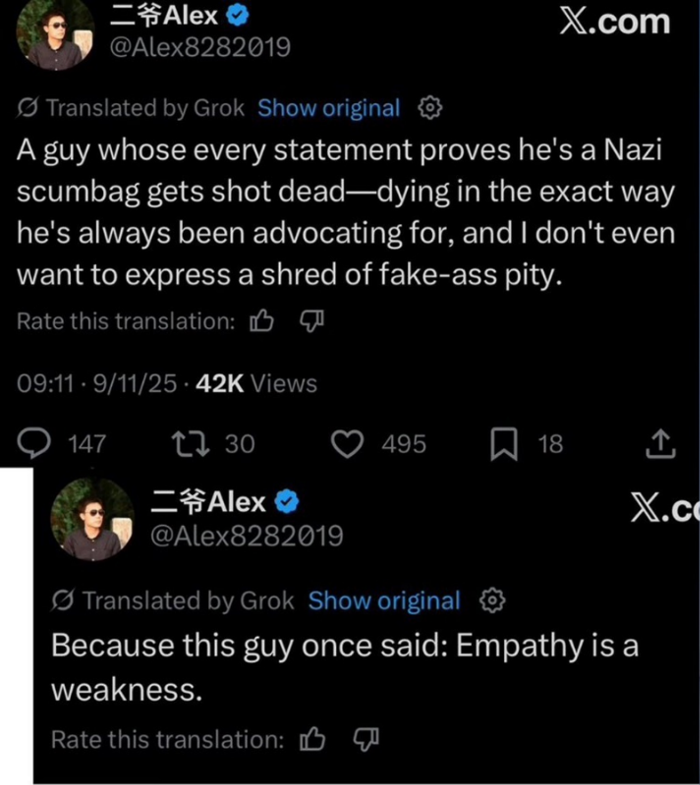
Posts displayed under @Alex8282019 on X. The English text shown is Grok’s translation.
Deng says he graduated from the People’s Public Security University of China, spent seven years as a criminal investigator in Guangzhou’s Huangpu District, and then moved into local government. He says Chinese authorities repeatedly summoned him for questioning, searched his home, and placed him under surveillance because he criticized the Chinese Communist Party. He reportedly came to the United States in late 2019, sought asylum, and subsequently obtained permanent residence. Restoration News reported that he renewed his Chinese passport at a consulate and used it for trips to Japan, Peru, Mexico, and Europe. A person who genuinely fears political persecution might hesitate to renew or rely on a passport from the country they fled. That makes the timing and circumstances worth examining under the rules governing voluntary reavailment of protection.
His public remarks are central to the controversy. After Kirk’s killing, Secretary of State Marco Rubio said the United States would revoke visas of foreigners who celebrate the murder of political figures. Green-card holders have different protections, and the debate over visas should prompt scrutiny of how the government addresses genuine threats and unlawful incitement. I also object to commentators who claim to oppose the Chinese Communist Party while, in my view, echoing its messaging. Some compare Donald Trump to Xi Jinping or amplify claims of racial discrimination. Those views can be debated on their merits. Any allegation of coordination with a foreign government requires evidence.
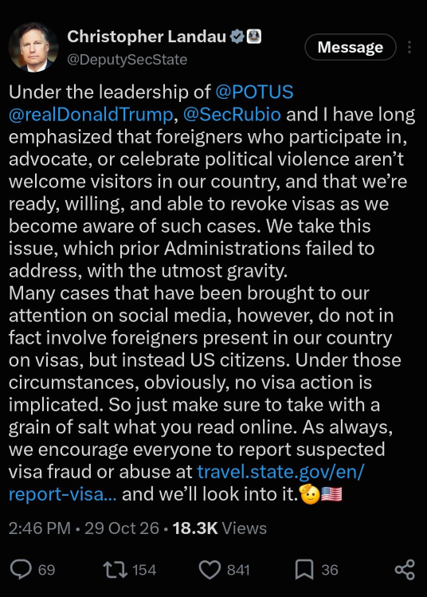
Christopher Landau’s October 29, 2026 X post on visa revocations for foreign visitors.
The case raises questions about enforcement of the Immigration and Nationality Act. Asylum protects people facing persecution and may lead to lawful permanent residence. Immigration authorities and judges can review eligibility where there is evidence of material inconsistencies or fraud. Passport renewal, travel records, and statements about past persecution can help establish a timeline. A finding of fraud or willful misrepresentation of a material fact can make someone inadmissible under INA § 212(a)(6)(C), subject to applicable exceptions and waivers. I also favor examining credible evidence of foreign influence in Chinese-language media, including any documented ties to the Chinese Communist Party’s United Front operations.
From a national security and traditional values perspective, the issue goes further. Kirk championed life, family, faith, and limited government, values central to many American evangelicals and conservatives. Celebrating a political murder is an affront to a society that depends on disagreement without violence. The evangelical command to love one’s neighbor is compatible with protecting the persecuted and guarding against abuse. A conservative immigration policy can welcome immigrants while expecting respect for the constitutional order and for human life.
I propose four measures. First, systematically review asylum grants based on claims of political persecution in China, checking whether travel and passport records contradict material statements. Second, consider public celebration of murder and extremist advocacy when reviewing later immigration benefits, within the limits of applicable law. Third, strengthen transparency in Chinese-language media by requiring commentators who receive public funding or have substantial influence to disclose past ties to the Chinese government. Fourth, accelerate border and asylum reform and consider how applicants’ conduct reflects respect for American constitutional principles.
Asylum should never become a license to undermine the country that offered refuge. Reports that a former Chinese police officer obtained a green card, traveled internationally on a Chinese passport, and celebrated the murder of an American conservative leader deserve scrutiny. The United States should protect people genuinely fleeing persecution and investigate credible allegations of fraud. Both are essential to public trust in the asylum system.
関連記事
California Sanctuary Policies Draw Renewed Scrutiny as Local Authorities Ignore ICE Detainers and Release a Four-Times-Deported Man With a Child Molestation Conviction
A Riverside County release and a separate Santa Clara County bail case renew debate over how California agencies respond to federal immigration detainers.
Faces of Chinese Illegal Immigration
Chinese border encounters jumped roughly seventyfold in two years while asylum delays, state programs, and short-video “success” clips turned illegal entry into a magnet. Faces along the route — activists, lawyers, influencers — show how arrival comes first and status last.
コメント
コメント 0 件. アカウント不要。
最初のコメントを残しましょう。